










.webp)

.webp)


.webp)


.webp)
.webp)


.webp)

.webp)

.webp)
.webp)

.webp)
.webp)


.webp)






















































.webp)


.webp)





















COGNITIVE THERAPY
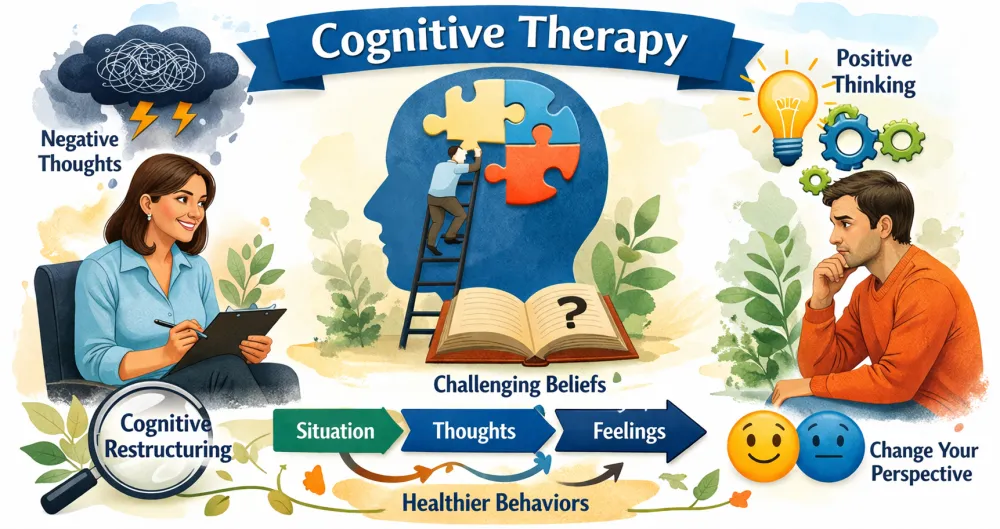
Cognitive therapy is a type of psychotherapy that is founded on the idea that how we think about things influences how we feel emotionally. Cognitive therapy is a problem-solving approach that focuses on current thinking, behaviour, and communication rather than past experiences. Cognitive therapy has been used to treat a wide range of issues, including depression, anxiety, and panic attacks. Cognitive therapy is also known as cognitive behaviour therapy since it tries to improve people’s thinking (cognitive) and acting (behavioural) skills (the behavior). For example, cognitive therapy has been used to help cocaine addicts overcome their addiction to the drug and other narcotics. The fundamental idea is that learning mechanisms play a key role in the emergence and persistence of cocaine misuse and dependency. Individuals can use the same learning mechanisms to help them cut down on their drug use.
Cognitive Therapy (CT) is a highly structured, goal-oriented form of psychotherapy based on the "Cognitive Model." This model posits that our emotions and behaviors are not determined directly by situations, but by the interpretation (thoughts) of those situations.
Developed by Dr. Aaron T. Beck in the 1960s, it focuses on the "here and now," helping clients identify and change distorted thinking patterns that lead to emotional distress and self-sabotaging actions.
Thought---What we tell ourselves.---"I'm going to fail this presentation."
Feeling ---The emotion triggered.---Anxiety, dread, physical tension.
Behavior---What we do as a result.---Avoiding the meeting or over-preparing until exhausted.
Clinical Depression: To break the cycle of self-critical and hopeless thinking.
Anxiety & Panic Disorders: To de-escalate the "catastrophic" thoughts that lead to panic.
Phobias: To systematically dismantle the irrational fears associated with specific objects or situations.
Low Self-Esteem: To identify and "update" the old mental scripts that say you aren't "good enough."
The ultimate result of Cognitive Therapy is Mental Autonomy. You stop being a victim of your "moods" and start understanding the "mechanics" behind your feelings. By changing the "lens" through which you view the world, you change the world itself. You leave therapy with a "Mental Toolbox" that allows you to handle future stresses with logic, resilience, and self-compassion.
Cognitive Therapy (CT) is a highly structured, goal-oriented form of psychotherapy based on the "Cognitive Model." This model posits that our emotions and behaviors are not determined directly by situations, but by the interpretation (thoughts) of those situations.
Developed by Dr. Aaron T. Beck in the 1960s, it focuses on the "here and now," helping clients identify and change distorted thinking patterns that lead to emotional distress and self-sabotaging actions.
Thought---What we tell ourselves.---"I'm going to fail this presentation."
Feeling ---The emotion triggered.---Anxiety, dread, physical tension.
Behavior---What we do as a result.---Avoiding the meeting or over-preparing until exhausted.
Clinical Depression: To break the cycle of self-critical and hopeless thinking.
Anxiety & Panic Disorders: To de-escalate the "catastrophic" thoughts that lead to panic.
Phobias: To systematically dismantle the irrational fears associated with specific objects or situations.
Low Self-Esteem: To identify and "update" the old mental scripts that say you aren't "good enough."
The ultimate result of Cognitive Therapy is Mental Autonomy. You stop being a victim of your "moods" and start understanding the "mechanics" behind your feelings. By changing the "lens" through which you view the world, you change the world itself. You leave therapy with a "Mental Toolbox" that allows you to handle future stresses with logic, resilience, and self-compassion.